
OnlyFans Stunts: How Creators Manufacture Scandals for Media Attention

OnlyFans creators use extreme stunts and fake controversies to manipulate media and turn outrage into marketing.

Every week there’s a new “shocking” OnlyFans story going viral.
An OnlyFans model sleeps with 100 men. Another claims she broke a world record. Another announces something so extreme that everyone starts talking about it.
Social media explodes. Tabloids write headlines. TV shows invite “experts”. People argue in comments.
And almost nobody stops to ask the most important question:
Is this even real?
Most of the time, it doesn’t matter. Because these stories are not real life. They are just marketing, the same way many of lawsuits against OnlyFans are, along with fake beefs, staged breakups, and scripted drama.
Stunts Are Not Accidents, They Are Strategy
In marketing, a stunt is a planned action designed to get attention. It doesn’t need to be true. It just needs to be shocking enough to spread.
OnlyFans creators use the same logic as influencers, reality TV, PR agencies, and viral marketers. The idea is always the same: create something extreme, let social media react, let the media pick it up, and then convert all that attention into subscribers.
Controversy is cheaper than advertising and much more effective.
The Problem With These Claims: Nobody Can Verify Them
Take the classic example: someone says “I slept with 50 men in one night” or “I had sex with 100 men in 24 hours” or “I broke a world record”.
Who confirms this? There is no independent witness, no official record, no real proof. It’s just the creator’s word.
But that’s enough.
Because the internet doesn’t run on facts. It runs on reactions.
The story works even if it’s completely fake.
Journalism Doesn’t Even Try Anymore
This is where things get embarrassing.
Most media outlets don’t investigate anything. They just copy tweets, embed TikToks, rewrite Reddit threads, and quote Instagram captions.
There is no verification, no critical thinking, and no fact-checking. Journalism has become content recycling.
If it’s viral, it’s “news”. If it’s shocking, it’s “important”. If it’s trending, it’s “real enough”.
Traditional media now behaves like a reaction channel.
When Traditional Media Falls for Influencer Marketing
What’s even crazier is that TV news shows now report influencer stunts as real events.
They treat TikTok drama as social issues, OnlyFans marketing as public debate, and fake scandals as cultural analysis.
Marketing campaigns are now reported as reality.
The line between journalism and influencer PR is basically gone.
Case Studies: When Stunts Become Headlines
All of this becomes very clear when you look at specific examples.
Lily Phillips: The Classic Viral Formula
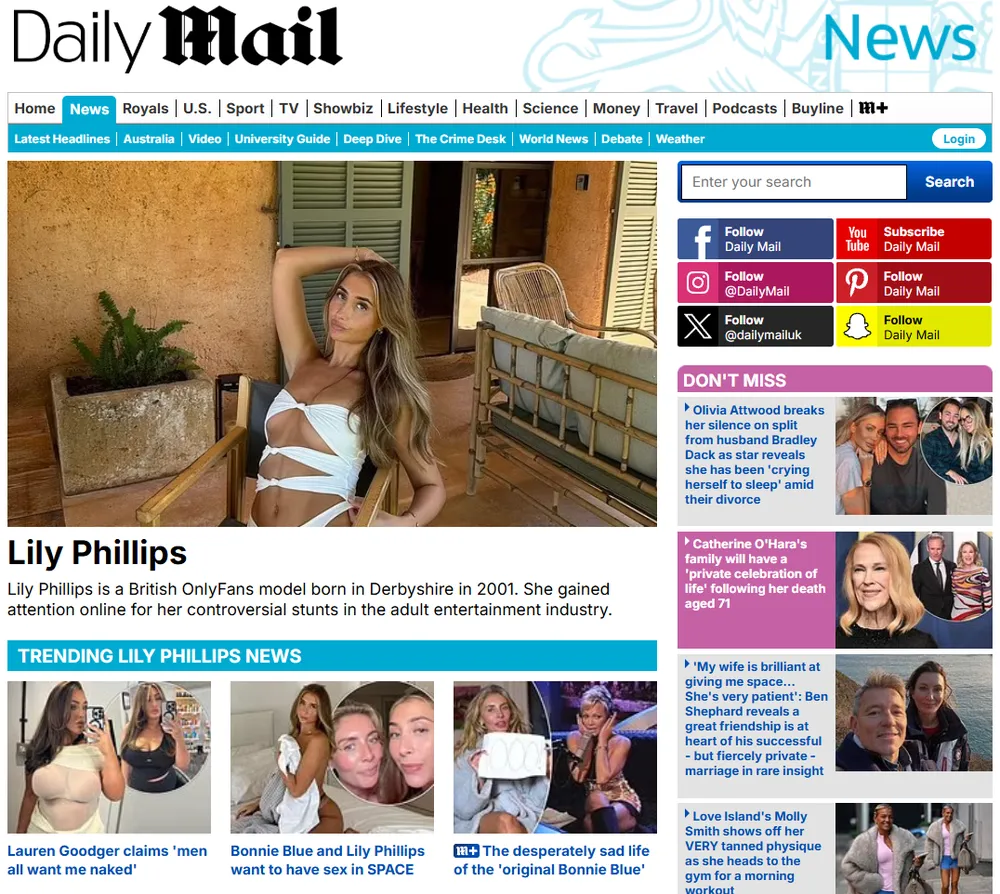
Lily Phillips is a perfect example of how this system works.
She makes extreme sexual claims, social media reacts, tabloids write about it, blogs copy each other, YouTubers make videos, and everyone debates if it’s real.
And the result is always the same. Her name explodes on Google, her social media grows, and her OnlyFans gets massive exposure.
Whether the story is true or fake is irrelevant. The stunt worked.
Bonnie Blue: Shock as Brand Identity
Bonnie Blue follows the same pattern.
Extreme claims, explicit narratives and moral outrage.
Her scandals become her brand. She is not selling content anymore, she is selling controversy.
People subscribe not just for porn, but for the story around her. The character is more important than the reality.
Ultimately, the same stunts that made her famous also got her permanently banned from OnlyFans.
Andressa Urach: The Ultimate Shock Tactic
Then there is the Andressa Urach case, which shows how far this can go.
She announced a controversial video involving her own son. Immediately, social media exploded, moral panic spread everywhere, tabloids reported it, and people were outraged.
At the time, there was no confirmation, no real evidence, and no verified content.
But it didn’t matter.
Even the possibility of incest was enough to generate massive traffic, trigger global discussion, and put her name everywhere.
This is the purest form of shock marketing.
The content doesn’t even need to exist. The rumor alone is enough.
Other Stunts That Have Nothing to Do With Sex
Not all OnlyFans stunts are even sexual. Some creators realized that shock doesn’t need nudity anymore. It just needs controversy.
In fact, some of the most viral OnlyFans stories have nothing to do with sex at all. They are pure attention stunts designed to trigger outrage, disgust, or moral panic.
One example is an OnlyFans model who went viral after doing a “weather stunt” during Hurricane Helene.
The story was framed as “disgusting” and “insensitive”. Media outlets accused her of using a natural disaster for self-promotion. Social media exploded with people calling her irresponsible and disrespectful.
But again, look at the result.
Her name went everywhere. News sites wrote about it. TikTok reacted. Twitter argued. Everyone suddenly knew who she was.
The backlash was the marketing.
Whether people hated her or defended her didn’t matter. The goal was visibility, and she got it.
Another viral case involved a model being filmed leaving lingerie inside a supermarket, right next to food products.
The video was shared as something “disgusting”, “unsanitary”, and “attention seeking”. People were angry, shocked, and debating hygiene, public behavior, and social decline.
But the real story wasn’t about hygiene.
It was about reach.
The clip went viral. Media picked it up. The model’s name trended. Her OnlyFans link got thousands of new clicks.
The stunt cost nothing and generated more exposure than any paid ad campaign.
Outrage Is the New Growth Hack
In modern internet culture, outrage is a growth strategy.
Instead of paying for ads, creators do something extreme, let people get angry, let media amplify it, and then turn hate into clicks and clicks into money.
Disgust works better than marketing. Moral panic works better than SEO. Scandal works better than talent.
Being hated is often more profitable than being liked.
The Psychology Behind Why This Works
Humans are wired to click on scandals, share shocking stories, judge sexual behavior, and feel morally superior.
These stunts exploit curiosity, voyeurism, moral judgment, and social comparison.
People say they hate it, but they can’t stop watching it.
Why Nobody Cares If It’s Fake
Because everyone benefits.
Creators get subscribers, brand growth, and media exposure. Media gets traffic, engagement, and clicks. Platforms get watch time, comments, and shares.
The only losers are truth, journalism, and public intelligence.
Fake stories perform better than real ones.
OnlyFans Stunts vs Real News
Now compare this with real problems in the world.
Wars, economic crises, corruption, climate disasters, and human rights violations affect millions of people every day.
But an influencer claiming to sleep with 100 men gets more headlines than most of these issues.
That tells you everything about modern media priorities.
The Future: Even Bigger and Darker Stunts
This is not slowing down. It’s accelerating.
As attention becomes harder to get, claims will get more extreme, topics will get darker, lines will be pushed further, and taboo will become normal.
With AI girlfriends, VR sex, and deepfakes, future stunts will be even more absurd and disturbing.
Reality will become optional content.
Conclusion: The Pornification of News
OnlyFans didn’t corrupt journalism.
Journalism adapted to the logic of OnlyFans.
News is no longer about facts. It’s about entertainment, outrage, virality, and clicks.
These stunts are not scandals. They are not accidents. They are not mistakes.
They are just very effective marketing campaigns disguised as news.
And in the current media system, that’s exactly how you win.